Optimism as an Infrastructure

In the early days of a software startup, optimism is easy to find. It’s fuel. It’s the energy that gets a founder through a weekend of coding or a marathon of discovery calls. But as a team grows from five people to twenty, and then to fifty, that raw, unbridled optimism often begins to feel… expensive.
It feels expensive because, without a system to support it, optimism starts to look like denial.
When a founder tells a team “we can hit this milestone by Friday,” but the engineering team is currently buried under a mountain of undocumented technical debt and a deployment pipeline that breaks every time someone looks at it sideways, that optimism doesn’t inspire. It exhausts.
I’ve spent a lot of time in these “war rooms.” I’ve seen brilliant founders and world-class engineers staring at whiteboards, trying to solve the same problem for the fourth time in a month. The common thread isn’t a lack of talent or a lack of vision. It’s a lack of infrastructure.
Not technical infrastructure, though that’s usually part of it, but operational infrastructure.
Operational clarity is the invisible system that makes optimism possible. It is the realization that calm isn’t a personality trait; it’s a byproduct of a business that knows how it works.
The Cost of the Invisible Fire
Most startups operate in a state of perpetual firefighting. We’ve glamorized it. We call it “hustle.” We talk about “pivoting” when we’re actually just flailing because we don’t have a clear way to make decisions.
But the cost of a “firefighting” culture is higher than most founders realize. It’s not just the burnout. It’s the opportunity cost. When your best people are spending 60% of their mental energy navigating internal ambiguity, wondering who owns the final sign-off on a feature, searching for the latest roadmap, or waiting for a meeting to get permission to move, they aren’t building.

In a SaaS environment, this ambiguity usually lives in the gaps between teams. Product thinks Engineering is building one thing; Engineering is actually fixing a “digital plumbing” leak that nobody documented; and Sales is promising a third thing to a high-value lead.
When the infrastructure is broken, optimism dies because the team stops believing that “better” is actually coming. They start bracing for the next fire instead of looking for the next breakthrough.
Making the Invisible Visible
Building “optimism as an infrastructure” starts with a very unglamorous task: making the invisible visible.
In my work as an operator, I don’t start with complex frameworks. I start by asking, “How does work actually get done here?” Not how the org chart says it happens, but how it actually happens on a Tuesday at 2:00 PM when a server goes down or a customer requests a refund.
Operational clarity inside a growing software startup requires four pillars:
1. Ownership Over Tasks
We often assign people “tasks” instead of “outcomes.” In a clear system, everyone knows their decision rights. If an engineer owns the reliability of a specific microservice, they shouldn’t need a three-hour meeting to decide on a patch. They should have the metric (uptime), the tool (the deployment pipeline), and the authority to act.
When people own outcomes, they don’t wait for permission. They act with the quiet confidence that comes from knowing exactly where their boundaries are.
2. The Living Roadmap
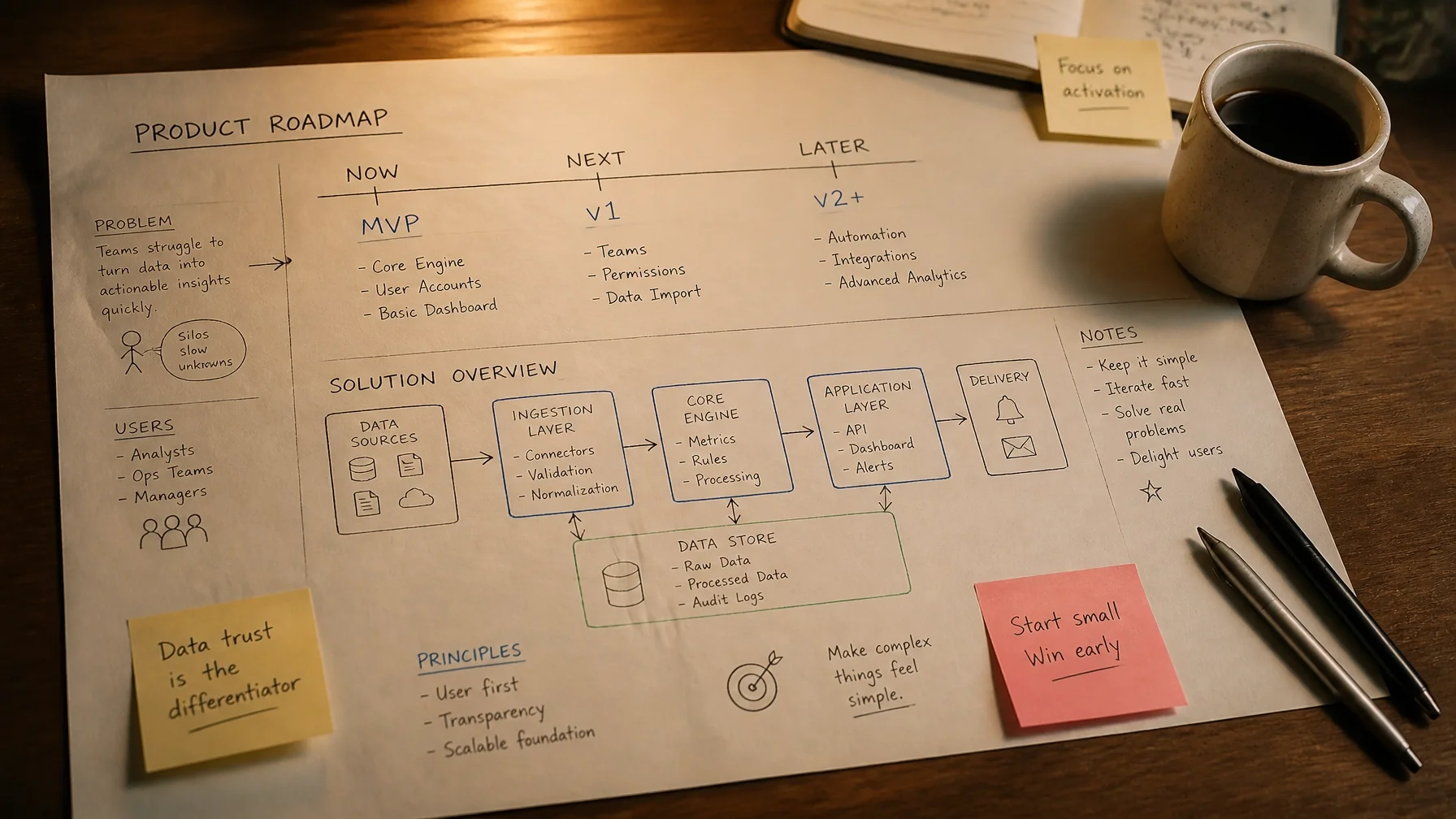
A roadmap shouldn’t be a static PDF that sits in a founder’s “Drafts” folder. It needs to be a lived-in architectural sketch of the future. It’s the shared truth that allows a developer to say “no” to a distraction because they can clearly see the “yes” they are working toward.
3. Decision Protocols
Chaos grows in the space between meetings. If your team has to wait for a “sync” to make every minor prioritization call, your velocity will inevitably drop to zero. Establishing a decision protocol: who is responsible, who needs to be consulted, and who just needs to be informed: removes the friction that slows down scaling.
4. Digital Plumbing (The Workflows)
Every SaaS business has core “plumbing” that keeps it alive. Lead-to-customer flows, deployment pipelines, incident response. If these are “tribal knowledge”: meaning they only live in the heads of the first three employees: they are a liability. Documenting these high-impact workflows isn’t about bureaucracy; it’s about freedom. It’s about ensuring that when you hire your tenth engineer, they don’t have to guess how to push code to production.
The Transition to Future-Building
Once the infrastructure of clarity is in place, something remarkable happens. The “war room” intensity fades. The frantic Slack messages at 9:00 PM start to disappear.
This is what I call the Fire Marshal approach. Instead of being the best firefighter in the company, the operator builds the systems that prevent the fire from starting in the first place.
When the team knows how decisions are made and where the business is going, they regain their “AI dividend”: the headspace and time to actually think. This is where the AI dividend isn’t about output, but about the quality of the problems you’re solving.

Optimism returns, but this time it’s grounded. It’s the optimism of a team that knows their foundations are solid. They can be ambitious because they aren’t afraid of the system collapsing under the weight of their own growth.
Calm is Scalable
Founders often fear that “process” will kill their culture. They worry that documentation and structure will turn their scrappy startup into a slow-moving corporate machine.
But I’ve observed the opposite. The companies that scale without losing their souls are the ones that embrace the relief of a clear direction. They realize that “scrappy” is only fun for so long. Eventually, your team wants to do their best work without having to navigate a maze of ambiguity every morning.

Operational clarity isn’t a one-time project. It’s a practice. It’s the quiet, daily commitment to bringing order to complexity so that your team can do something extraordinary.
If your startup feels like a collection of brilliant people trapped in a cycle of chaos, let’s talk about building the infrastructure that sets them free. We can turn that messy, ambiguous tech challenge into a sleek, simple, and scalable solution.