The AI Dividend Isn’t About Output
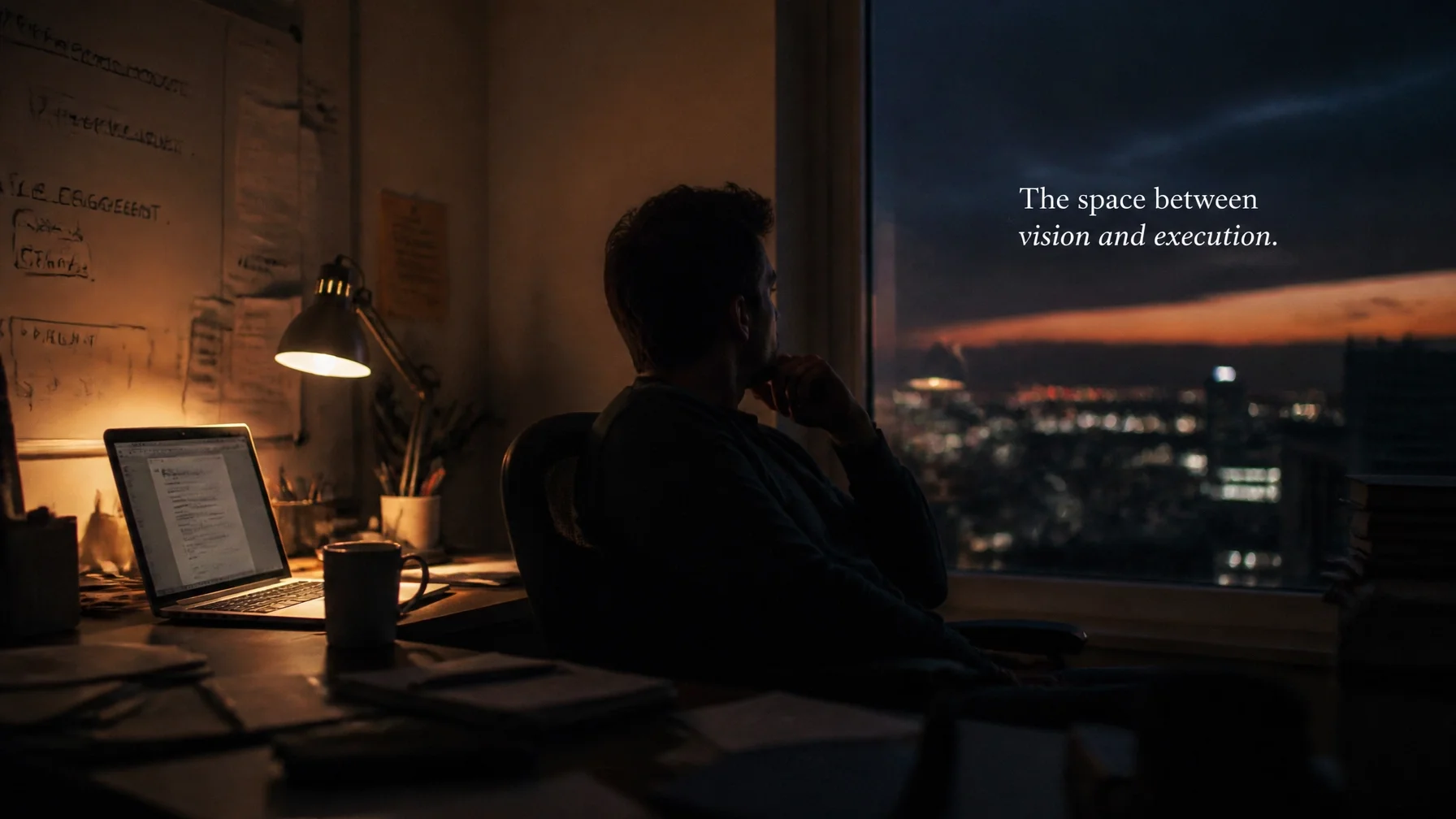
I was sitting in a dimly lit office last Tuesday, the kind of quiet that only happens after 7:00 PM when the air conditioning finally hums a little lower and the Slack notifications stop their relentless pinging.
“Everything is faster now, Penny,” he said, not looking up. “The code reviews are faster. The copy for the new campaign was done in seconds. The research that used to take my intern a week took me ten minutes this morning.”
He paused, then finally looked at me. His eyes weren’t bright with the thrill of innovation. They were tired.
“So why do I feel like I’m further behind than I was last year?”
It’s a question I’m hearing more often lately. We’re living through the Great Acceleration. We have tools that can draft our emails, automate our lead gen, and bridge the gap between a messy product vision and a shippable feature in record time. We are seeing the arrival of the “AI Dividend”: that massive surplus of time and capacity that was promised to us by the promise of automation.
But here is the observation from the trenches: Most founders aren’t banking that dividend. They’re immediately reinvesting it into more chaos.
The Stolen Dividend
In finance, a dividend is a distribution of profits. It’s the reward for the work the system has done. In a startup, the AI dividend should be a distribution of time. It’s the three hours you didn’t spend writing a technical spec. It’s the half-day you saved because your front-office operations are now running on a streamlined, LLM-powered loop.
Theoretically, that time belongs to you. You could use it to think. You could use it to sit with your head of engineering and talk about the long-term architecture. You could use it to go home and actually be present for dinner.
But that’s not what’s happening.
Instead, the moment an AI tool saves a founder an hour, they use that hour to cram three more tasks into the backlog. Because the execution is “easier,” the volume of execution is expected to be higher. We’ve turned a tool meant for liberation into a tool for higher-intensity incarceration. We are using our new-found efficiency to build a faster treadmill, and then we wonder why we’re out of breath.

The Efficiency Trap
I’ve spent my career as an operator, the person who steps into the “beautiful startup chaos” and tries to build the systems that let people actually do their best work. What I notice, more often than not, is that complexity doesn’t scale linearly: it scales exponentially.
When you use AI to double your output, you don’t just double your results. You triple your complexity. Every new feature generated by an AI co-pilot needs a human to validate its strategic fit. Every automated marketing campaign needs a human to ensure the brand voice hasn’t lost its soul. Every streamlined workflow creates new edge cases that eventually land on a human desk.
The “Invisible Operator” knows that the real work isn’t the output itself; it’s the decisions behind the output.
When you reinvest 100% of your AI dividend into more “doing,” you are systematically starving yourself of the time needed for “deciding.” You are trading your high-leverage strategic thinking for a high-volume tactical noise.
This is how companies end up with 50 features that no one uses, or 100 blog posts that no one reads. They were “efficiently” produced, but they lacked the human intentionality that makes them valuable. They filled the space between vision and execution with more stuff, rather than more meaning.
The Case for Retained Earnings
If we treat time like a currency, we need to start thinking about “retained earnings” for the human spirit.
In the trade businesses I work with, this shows up just as clearly as it does in high-growth SaaS. An owner automates their scheduling and dispatch, saving ten hours a week. Instead of using those ten hours to train their technicians or improve their customer experience, they take on five more jobs that they aren’t quite staffed for. The revenue goes up, but the quality drops, the stress spikes, and the culture begins to fray at the edges.
They’ve spent the dividend before the check even cleared.
True operational excellence: the kind that creates a calm, scalable company: requires us to be disciplined enough to keep some of that saved time for ourselves.

I often tell founders that “calm is scalable.” If your organization is constantly running at 110% capacity, any minor bump in the road: a key employee leaving, a market shift, a technical bug: becomes a catastrophe. You have no margin for error because you’ve used your AI-boosted efficiency to eliminate all the “slack” in your system.
But slack is where the magic happens. Slack is where the breakthrough idea comes from during a coffee conversation that wasn’t on the calendar. Slack is where you notice that your team is burning out before they actually quit. Slack is the buffer that turns a chaotic startup into a resilient organization.
Reclaiming Your Humanity
The promise of AI isn’t that it will make us into better machines. It’s that it will handle the machine-like tasks so we can be better humans.
We don’t need founders who can produce 10x more emails. We need founders who have the mental space to ask “Should we be sending this email at all?” We don’t need product managers who can churn out 100 user stories a day. We need product leaders who have the time to sit in a room with a customer and truly empathize with their pain, without checking their watch because the “AI-enhanced” roadmap is breathing down their neck.
When I work with teams to tighten their discovery loops or accelerate their feature delivery, the goal isn’t just speed for the sake of speed. The goal is to create certainty. And once you have certainty, you can afford to slow down.
The most extraordinary products aren’t built by the fastest teams; they’re built by the most thoughtful ones. They are built by teams who have the discipline to use their technological superpowers to buy back their focus.
The Observation
As the night wore on in that quiet office, my founder friend finally closed his laptop. He looked around the room: the sticky notes on the wall, the empty coffee cups, the physical artifacts of a team trying to build something that matters.
“I think I’m going to go home,” he said. “I saved four hours today using those new prompts for the quarterly report. I was going to use them to start the next project, but I think I’m just going to go home and play with my kids.”
He smiled, and for the first time that day, the exhaustion was gone.
That is the real AI dividend. It’s not the 1,000 words the LLM wrote for you. It’s the permission to stop. It’s the space to remember why you started this company in the first place.
The next time you find yourself moving faster than ever, ask yourself: Am I banking the dividend, or am I just feeding the machine?
Because at the end of the day, your company doesn’t need a faster treadmill. It needs a leader who knows when to step off of it.

I’m Kristie. I help founders and trade business owners turn messy tech challenges into simple, scalable systems. If you’re tired of the treadmill and ready to build some calm into your chaos, let’s talk.