The Relief of a Clear Direction
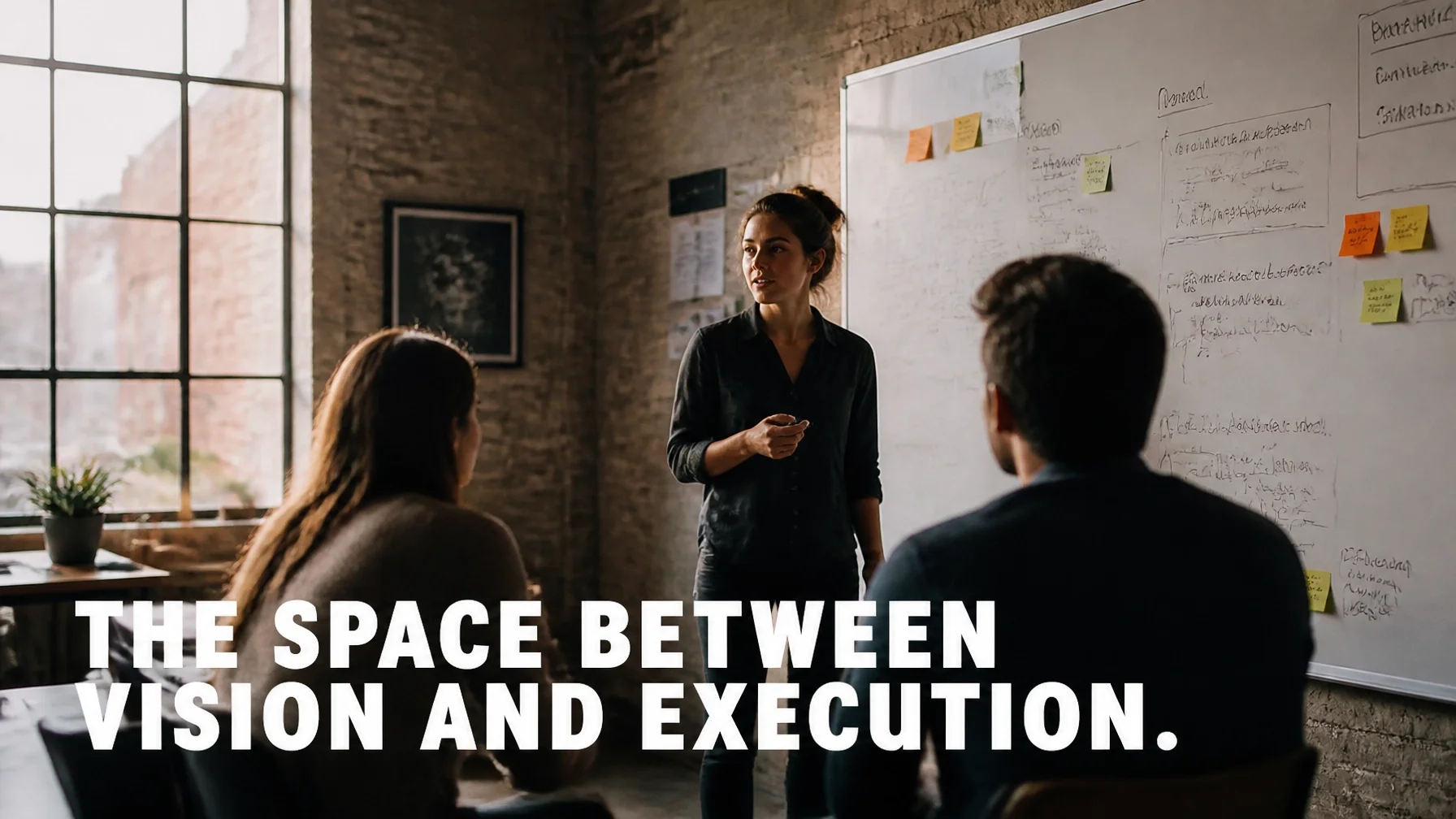
I was sitting in the corner of a product room last week, just watching. It’s what I do.
The air was heavy, the kind of thick, static tension that settles over a team when they’ve been “running hard” but aren’t sure if they’re actually gaining ground. The founder was at the front of the room, explaining the vision for the next eighteen months. It was a beautiful vision, lofty, ambitious, and strategically sound. But as he spoke, I watched the lead engineer’s eyes. They weren’t focused on the horizon. They were darting around the room, looking for a place to land.
Later, over coffee, that engineer told me: “I love the vision. I really do. But I don’t know what I’m supposed to ship on Monday that actually matters.”
This is the hidden tax of the scaling startup. We confuse vision with direction, and we confuse certainty with clarity.
Founders often feel they can’t speak until they are certain. They wait for more data, more market signals, or more “finalized” plans. But while they are waiting for certainty, the team is starving for clarity. And in that silence, chaos grows.
The Trap: Waiting for Certainty
In the early days of a startup, certainty is a myth. You are building the plane while flying it, often in a fog. If you wait until you are 100% sure of the destination before you give your team a command, you will stall.
I’ve seen it happen in tech hubs and in field service trailers alike. When a leader is silent because they aren’t “sure” yet, the team doesn’t just sit still. They start building their own versions of the truth. They prioritize based on what’s easiest or what’s loudest.
Certainty is about the outcome. Clarity is about the shared understanding for collective action.
Your team doesn’t need you to promise them that the market will stay exactly as it is for the next three years. They need you to tell them exactly what we are optimizing for for the next three weeks. They need the relief of a clear direction.

The Compass vs. The Map
When I step into a company as an operator, one of the first things I look for is the “alignment gap.” Usually, it’s not because people don’t care; it’s because they are trying to follow a map that doesn’t exist yet.
Maps are for stable environments. They show you every turn, every landmark, and every stop. But startups are uncharted territory. If you try to give your team a map for a landscape that is still shifting, the first time you hit a road closure, the whole team gets lost.
What they need instead is a compass.
A compass doesn’t tell you where the rocks are, but it tells you which way is North. In a product organization, “North” might be “Reducing friction in the onboarding flow.” In a trade business, “North” might be “First-time fix rate.”
When you provide a compass, you give your team the agency to navigate the obstacles themselves while staying aligned. This is the secret to operational excellence. It moves the burden of “every single decision” off the founder’s shoulders and places it into a framework where the team can act with confidence.
The Psychological Relief of Alignment
We often talk about alignment in terms of efficiency, but we rarely talk about it in terms of humanity.
There is a profound psychological relief that comes when a team is told: “This is what matters most right now. Everything else is secondary.”
I have seen developers who were on the verge of burnout suddenly find a second wind because their “To-Do” list of fifty items was cut down to three clear priorities. I have seen field teams go from grumpy and reactive to focused and proud because they finally understood how their daily work connected to the company’s “North.”
Burnout in startups isn’t always about the hours worked. Often, it’s about the mental load of trying to prioritize in a vacuum. It’s the exhaustion of wondering if you’re working on the “wrong” thing.
When you provide clarity, you aren’t just improving execution; you are protecting your team’s mental energy. You are allowing them to do their best work without the nagging fear of misalignment.

How to Create Operational Clarity
So, how do you actually do this? How do you align a team when you yourself feel the weight of the unknown?
It starts with acknowledging that clarity is a commitment, not an absence of doubt. Here are the patterns I notice in teams that move fast without the chaos:
Define “What Wins”
In every startup, priorities will eventually collide. Your engineering team will have to choose between a new feature and technical debt. Your sales team will have to choose between a “whale” client that doesn’t fit the product and a smaller lead that does.
If you haven’t told them “what wins” ahead of time, they will hesitate. They will wait for a meeting. They will stall.
Example: “For the next 90 days, speed of learning wins over perfect UX.”
Example: “Customer retention wins over new customer acquisition until our churn is under 5%.”
Radical Simplification
If you have ten priorities, you have none. I’ve walked into rooms where founders have a “Top 10” list. By the time we get to item number four, the team has already tuned out.
Clarity requires the courage to say “no” to good ideas so the team can say “yes” to the great ones. Aim for 2-3 enterprise-level priorities. That’s it.
Translate Vision into “Monday Morning”
Vision is for the soul; execution is for the hands. As a founder, your job is to bridge the gap. If your vision is “To revolutionize the way people manage their homes,” your Monday morning instruction to the team should be “We are going to fix the bug in the scheduling calendar because that is the first point of contact for every user.”
The Space Between Vision and Execution
This work: the translation of big ideas into simple, actionable directions: is where startups succeed or fail. It is the “invisible work” of the operator.
It’s not glamorous. It’s about writing clear briefs, setting up decision-making frameworks, and sometimes just being the person who says, “Wait, are we all talking about the same thing?”
But when it works? The chaos subsides. Not because the work got easier, but because the path became clear. The team stops looking for the exit and starts looking for the next milestone.

If your startup feels chaotic, it might not be a lack of talent or a lack of hard work. It might just be a lack of clarity.
You don’t have to be certain about the next five years to be clear about the next five days. Give your team the relief of a direction. Let them know where North is, and watch how fast they can run.
If you’re feeling the weight of the “alignment gap” and you’re ready to turn that beautiful vision into a simple, scalable reality, let’s talk. I help founders find the calm inside the ambition.